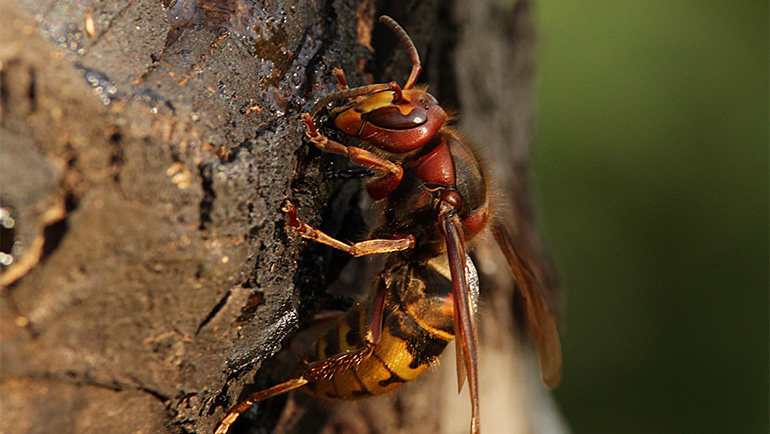
A large enclosed paper nest
Bald-faced hornets and aerial yellowjackets build covered paper nests above ground. The nest may appear under an overhang or hang from a tree, shrub, building edge, or protected structure.

Hornet nest inspection and treatment
A large enclosed paper nest near a doorway, roofline, tree, walkway, or play area can put people directly in the colony’s defensive zone. Bee Smart Pest Control identifies the stinging insect, evaluates the nest location, and recommends a property-specific treatment for homes and businesses across Colorado’s North Metro and selected Boulder County communities.
Direct answer
Keep your distance and avoid disturbing the nest or standing in its flight path. Professional service is the better next step when an enclosed paper nest is active, elevated, difficult to reach, attached to a structure, or close to doors, walkways, patios, play areas, customers, workers, or pets.
Tell Bee Smart where the nest is locatedInteractive nest-location scan
Select the location that best matches what you are seeing. The goal is not to diagnose the species from a distance. It is to identify the safest, most useful starting point for an inspection.
Use the buttons below or the arrow keys to move through the locations.
Warning signs
A hornet foraging away from a nest may not be a service issue. Repeated traffic, an enclosed paper nest, or defensive behavior near an occupied area points to a more immediate concern.
Bald-faced hornets and aerial yellowjackets build covered paper nests above ground. The nest may appear under an overhang or hang from a tree, shrub, building edge, or protected structure.
Workers moving in and out along the same route help reveal the colony’s active zone. Watch from a protected distance rather than approaching the opening.
Increased circling, close approaches, or repeated activity around doors, patios, play areas, equipment, or walkways can make normal use of the property difficult.
Can you see the nest but cannot safely reach it? That is useful information—do not get closer for a photo.
Call Bee SmartIdentification matters
Nest shape, body markings, and location are stronger clues than size alone. Bee Smart can help determine whether the activity fits hornet control, wasp control, yellowjacket activity, or a harmless lookalike.
Despite the name, the bald-faced hornet is a type of aerial yellowjacket. It is mostly black with white markings and builds a large, enclosed, gray paper nest above ground.
This social wasp also builds an enclosed paper nest above ground. Yellow-and-black markings can cause confusion with other yellowjackets, paper wasps, and insects people broadly call hornets.
An open-comb nest, ground opening, wall cavity, or large wood-associated insect may point to a different species and a different response. Some intimidating horntails cannot sting people.
Colorado State University identifies the bald-faced hornet and aerial yellowjacket as two Dolichovespula species found in Colorado. Review its Colorado bee and wasp identification summary.
Colorado hornet pressure
Social hornet colonies begin again each year. A queen starts a new nest, and the number of workers increases as the colony develops. A nest that was easy to overlook earlier in the season can become obvious once traffic increases or landscaping brings people closer to it.
North Metro homes and businesses offer protected nest sites around mature trees, dense shrubs, roof edges, sheds, detached structures, signs, play equipment, and building overhangs.
What to expect
The recommendation depends on the insect, nest location, access, activity level, property use, and proximity to people—not a generic treatment script.
Share where the insects appear, whether a nest is visible, and which areas people need to use.
The technician evaluates the insect, nest or entrance, flight path, access, and surrounding conditions.
Bee Smart explains the recommended service, preparation, access needs, and realistic expectations.
After active nesting is addressed, the team may recommend monitoring, sanitation, exclusion, or prevention.
Active nest near daily traffic?
Tell Bee Smart where the nest is located, how high it is, and whether it affects an entrance, patio, yard, walkway, work area, or customer space.
DIY or professional service?
Product range, nest height, wind, obstacles, and the colony’s flight path can place someone directly below or beside defensive insects. Knocking down the exterior envelope does not necessarily mean the active colony has been addressed.
Calling earlier can make access and planning simpler, especially before landscaping, exterior repairs, roofing, painting, pressure washing, or an outdoor event brings people closer to the nest.
Homes and businesses
A nest in a remote tree is a different problem from a nest above a front entrance, loading area, playground, outdoor dining space, or frequently used yard.
Home service may focus on activity around eaves, garages, porches, patios, decks, sheds, trees, shrubs, fences, play equipment, and other outdoor areas used by the household.
Business service considers employee and customer exposure, access restrictions, operating hours, landscaping, signage, rooflines, outdoor seating, loading zones, and maintenance schedules.
Prevention
Prevention cannot stop every queen from selecting a property, but early observation and practical property maintenance can reduce unnoticed nesting and food attraction around occupied areas.
Look at eaves, overhangs, trees, shrubs, sheds, signs, and play structures before foliage conceals activity.
Close garbage, clean sugary spills, remove fallen fruit, and manage food around patios and work areas.
Inspect the area before trimming, roofing, painting, pressure washing, mowing, or using a ladder.
Pay attention to structures and landscaping that supported aerial nesting in prior seasons.
Service area
Bee Smart Pest Control is based in Brighton and serves homes and businesses across North Denver, the northern Front Range, and selected Boulder County communities.
Related services
Stinging insects are frequently misidentified. Use the related pages below when the nest shape or activity does not match a large enclosed aerial nest.
Frequently asked questions
A large, fully enclosed paper nest above ground may indicate bald-faced hornets or aerial yellowjackets. Watch the flight path from a safe distance and note the nest shape, height, attachment point, and body markings. Do not approach the nest just to improve identification.
Yes. Colorado State University identifies the bald-faced hornet as one of the aerial-nesting Dolichovespula species found in Colorado. Despite its common name, it is a type of yellowjacket.
Do not strike or knock down an active nest. Disturbing the nest can place you in the colony’s defensive zone. Professional service is the better choice when the nest is active, elevated, enclosed, difficult to reach, or near people.
Keep people away and pause trimming, mowing, or branch work near the nest. Note the height and location without shaking the plant or moving closer. Tell Bee Smart whether the nest affects a walkway, yard, entrance, play area, or maintenance zone.
Social hornet colonies are annual, and old nests are abandoned. New queens can still select similar trees, shrubs, overhangs, or structures in later seasons when those locations continue to provide suitable shelter.
Bee Smart evaluates the insect, nest shape, attachment point, entrance, flight path, access, activity level, surrounding landscaping or structure, and proximity to occupied areas. The service recommendation is based on those findings.
A one-time service may be appropriate for a specific active nest. Properties with recurring seasonal wasp, yellowjacket, bee, or hornet pressure may also benefit from a prevention program. Bee Smart explains the option that fits the inspection findings.
Cost depends on the insect, nest location, height, access, activity level, property conditions, and the service recommended. Bee Smart provides a free estimate and explains the treatment before work begins.
Yes. Bee Smart serves homes and businesses. Commercial service can address nests near entrances, outdoor dining, customer walkways, loading areas, landscaping, rooflines, signs, equipment, and employee work zones.
Call Bee Smart Pest Control at 720-937-0527 or use the online contact form. Share where the nest or activity appears, whether the nest is visible, its approximate height, and how close it is to people or occupied areas.
Get help with an active nest
Tell Bee Smart where the nest is located, how high it is, and which parts of the property it affects. Get a clear recommendation for inspection, treatment, and prevention.